
Car
Argentina 3-1 Switzerland: World Cup Semifinal vs England Set
Jul
Argentina came through a nervy World Cup quarterfinal with Switzerland, prevailing 3-1 after extra time and earning a semifinal meeting with England, one of football’s most politically sensitive and emotionally charged matchups.
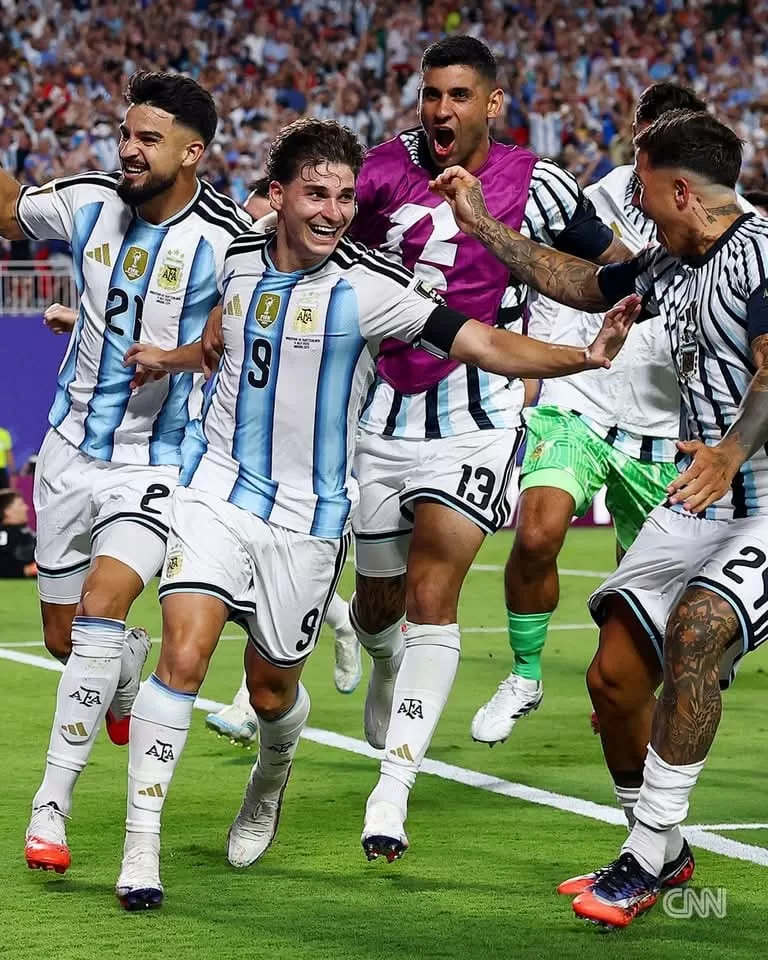
The reigning champions were taken late into the night in Kansas City before Julián Álvarez finally broke Switzerland’s resistance in the 112th minute with a decisive strike from distance. Lautaro Martínez added a third near the end to put the match beyond doubt, after Argentina had spent long stretches failing to convert possession and a man advantage into real command.
Argentina went in front during the first half when Alexis Mac Allister headed home from a Lionel Messi corner. At that point, Lionel Scaloni’s team seemed to be in familiar territory: leading a knockout game, roared on by a huge Argentine following, with Messi again at the heart of a key moment. Switzerland, however, refused to fold. Murat Yakin’s side stayed compact, combative and patient, and Dan Ndoye eventually brought them level in the 67th minute.
The key shift came around the same stage of the match, when Swiss forward Breel Embolo was shown a red card following a VAR review. The decision quickly became one of the quarterfinal’s main controversies. Switzerland felt the call was severe and costly; Argentina, repeatedly frustrated by the Swiss shape, slowly raised the pressure against ten men but still had to wait until extra time to find the winning goal.
For Switzerland, the loss hurt because this was the closest the team had come in decades to making a major breakthrough at World Cup level. The Swiss had never reached a World Cup semifinal in the modern era, and their run had been built on defensive discipline, Granit Xhaka’s leadership in midfield and a practical structure that made them hard to open up. Even down to ten men, they made Argentina fight until the closing minutes of extra time.
For Argentina, the win reinforced the pattern of their tournament: resilience has mattered more than fluency. Scaloni’s side is still alive in its bid to retain the World Cup, something no country has done since Brazil in 1962. Yet Argentina’s path has been anything but smooth. The champions have leaned on decisive contributions from senior figures and attacking depth, including Messi, Mac Allister, Álvarez and Martínez, rather than sweeping teams aside through sustained control.
Messi, now 39, is still central to Argentina’s campaign. Even when he does not score, his set-piece delivery, passing range and ability to occupy defenders continue to influence matches. His corner for Mac Allister’s opening goal was another example of how often Argentina’s defining moments still run through him. Tournament reports have also noted that Messi remains among the competition’s leading scorers, level near the top of the Golden Boot race with France’s Kylian Mbappé.
The semifinal against England now stands as the tournament’s marquee fixture. This is more than a contest between two elite sides; it is a match loaded with decades of history. The World Cup rivalry between Argentina and England includes the 1986 quarterfinal in Mexico, where Diego Maradona scored both the infamous “Hand of God” goal and one of the finest solo goals the sport has ever seen. It also features England’s dramatic penalty shootout defeat in 1998, along with later meetings that have kept the rivalry alive for new generations.
After the Switzerland match, Scaloni tried to lower the emotional stakes, describing the semifinal as simply “a football game” against a strong opponent. That may be the line inside the Argentina camp, but outside it, the match will mean far more. To Argentina supporters, England remains one of the most symbolic opponents in world football. For England, defeating Argentina on the road to a World Cup final would carry major historical significance of its own.
England booked its semifinal place with a 2-1 extra-time victory over Norway, with Jude Bellingham once again playing a central role in the team’s progress. The England squad blends tournament experience with attacking quality, led by players such as Bellingham and Harry Kane, while Argentina arrives with the stature of defending champion and the aura surrounding Messi’s final World Cup years.
The semifinal is set to take place in Atlanta, with the winner moving on to the World Cup final against either France or Spain. That route to the final only raises the stakes further: all four remaining sides rank among the strongest teams in world football, creating one of the most formidable semifinal lineups in recent memory.
For video producers, the narrative breaks into distinct strands: Argentina’s tense escape, Switzerland’s anguish, the disputed red card, Messi’s enduring impact, Álvarez’s decisive extra-time goal, and the approaching Argentina-England clash. The clearest visual storyline opens with Swiss defiance, moves into the VAR flashpoint, tightens around Argentina’s growing frustration, then explodes with Álvarez’s winner and the awareness that what comes next is more than a semifinal; it is a worldwide football spectacle.
Argentina were far from their sharpest. They did not have to be. World Cup champions often have to endure before they impress, and Scaloni’s team once again navigated its way through a match full of danger. England, however, will bring a different kind of challenge: more depth in attack, heavier physical pressure, and the mental weight of a rivalry that almost never feels routine.
After 120 minutes in Kansas City, Argentina’s defense of the title remains alive. Switzerland depart with both pride and regret. The World Cup now moves toward a semifinal shaped for the history books: Argentina versus England, with a place in the final on the line.
