
Car
Argentina Beats Switzerland 3-1, Sets England World Cup Semifinal
Jul
Argentina have returned to the World Cup semifinals, reaching this stage in a manner that felt unmistakably their own: enduring pressure, hanging on, and then producing the decisive moments when there was almost no room left for mistakes.
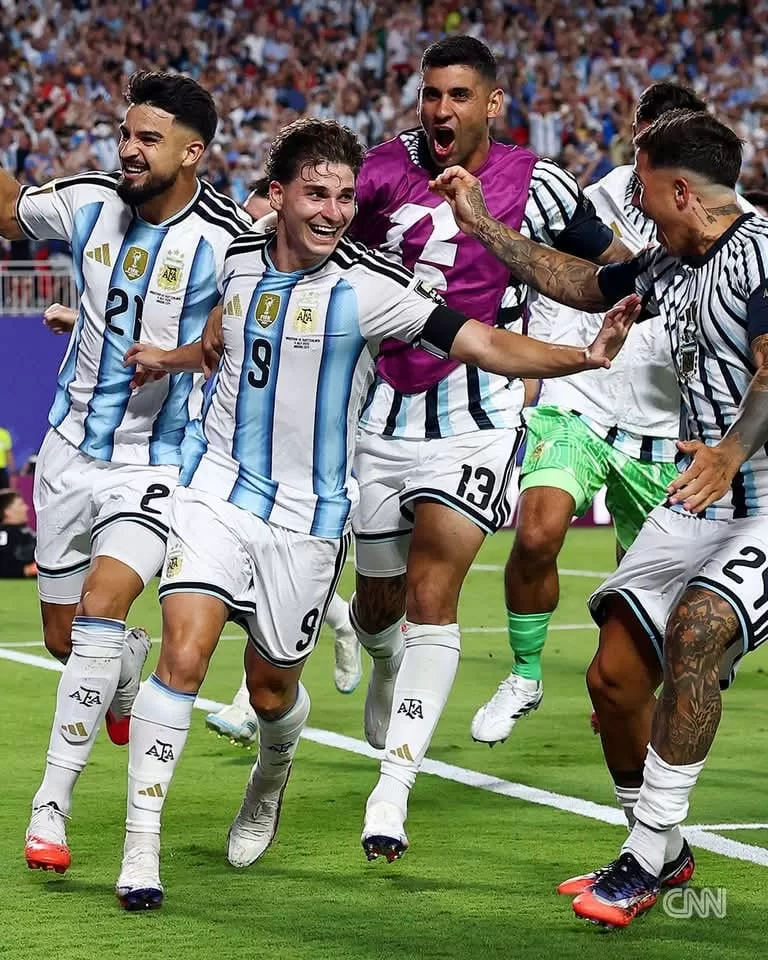
The reigning champions defeated Switzerland 3-1 after extra time at Arrowhead Stadium in Kansas City on Saturday, July 11, 2026, earning a high-profile semifinal meeting with England in Atlanta on Wednesday. Julián Álvarez finally broke through Switzerland’s resistance with a shot from distance in the 112th minute, before Lautaro Martínez struck late to make a tight quarterfinal look far more comfortable on the scoreboard than it had been.
For much of the evening, Lionel Scaloni’s team were made to work. Argentina took a first-half lead when Alexis Mac Allister finished from a Lionel Messi corner, but Switzerland settled into the contest and drew level in the 67th minute through Dan Ndoye after Ricardo Rodríguez found room to fashion the opening. By then, the match had all the signs of a familiar knockout shock: the favorite under strain, the outsider growing in confidence, and a heavily pro-Argentina crowd falling into anxious quiet.
The moment Switzerland will remember most bitterly came soon after their equalizer. Leandro Paredes was first shown a yellow card for a challenge on Breel Embolo, but after a video review, the officials decided Embolo had gone down before any contact. Since he had already been booked, the Swiss forward received a second yellow card and was sent off. The call was handled under the “mistaken identity” protocol, which permits VAR to step in when a card has been shown to the wrong player.
After the match, Switzerland coach Murat Yakin was livid, saying the ruling had altered the game and that his side had been hurt by an unacceptable application of the rule. The Swiss players shared that frustration, especially because the dismissal arrived just as they had taken control of the momentum. From there, Switzerland had to dig in for a long defensive spell with 10 men against a champion team that has often found solutions late in matches.
Argentina pressed aggressively near the end of regulation time. Mac Allister sent a header wide in the 89th minute, and Messi, whose nine-match World Cup scoring run ended that night, nearly found a winner in stoppage time. Switzerland survived those scares and forced extra time, still hoping to reach the World Cup semifinals for the first time. That wait goes on. This was their first quarterfinal since 1954, but they still have never made the last four and still have never beaten Argentina in eight encounters.
Álvarez eventually made the breakthrough with eight minutes remaining in extra time, hitting from range after finding space outside Switzerland’s defensive shape. Lautaro then added the clincher late on, keeping Argentina’s attempt to win consecutive World Cups alive. The victory also fit a broader pattern in their tournament: Argentina have not always dominated, but they have kept getting through difficult passages, including extra-time pressure against Cape Verde and a late comeback against Egypt in the previous round.
Messi was still central to Argentina’s night, even without scoring. At 39, he remains the team’s emotional and creative focal point, and his corner for Mac Allister’s opening goal was another example of the influence he continues to carry. He came into the match level with France’s Kylian Mbappé near the top of the scoring standings on eight goals, and his chase for a second World Cup title is still alive.
The semifinal with England now stands as one of the biggest matchups this tournament could have delivered. England booked their place in the last four earlier on Saturday with a 2-1 extra-time win over Norway in Miami Gardens. Jude Bellingham scored both goals for Thomas Tuchel’s team, first wiping out Andreas Schjelderup’s opener and then striking again in extra time. Tuchel criticized England’s display afterward, saying they had not been sharp enough technically, but the result left them one victory away from their first World Cup final since 1966.
Argentina versus England arrives with history attached. This fixture still evokes the 1986 World Cup, Diego Maradona’s “Hand of God” and “Goal of the Century,” and the political backdrop of the Falklands/Malvinas War. They have not faced each other at a World Cup since England’s 1-0 group-stage win in 2002, and this semifinal will be their first meeting in any competition since 2005. Scaloni later tried to lower the temperature, calling it “a football game” against an extremely strong side, but the emotion around it will be hard to set aside.
The tournament as a whole has produced a remarkable final four. Argentina and England are joined by France and Spain, so the four highest-ranked teams in FIFA’s world rankings have all made the semifinals. For FIFA, broadcasters and organizers, the matchup set could hardly be better: Messi’s Argentina pursuing history, England trying to end six decades of World Cup disappointment, France still driven by Mbappé, and Spain riding another surge at a major tournament.
Switzerland will see this elimination as a harsh one. They defended with discipline, matched Argentina physically and showed where the reigning champions could be hurt before the red card changed the direction of the match. For Argentina, the evening underlined a point bigger than style: champions often have to win in more than one way. Here, they required patience, sustained pressure, controversy and a single precise finish from Álvarez. England are next, in a semifinal heavy with football history.
