
Car
German POWs in Britain Visited Local Pubs—and Their Reaction Said It All
Jul
At 7:23 p.m. on October 14, 1944, Unteroffizier Friedrich Bowman waited outside a brick building in the village of Culworth, Northamptonshire. As laughter and music drifted through the wooden door, he stood listening, unable to make sense of what was unfolding.
Twenty-six years old, Bowman had been taken prisoner five weeks earlier in Normandy and brought across the English Channel aboard a hospital ship. He had expected to end up in the kind of prison camp described in Wehrmacht briefings: barbed-wire enclosures, hostile civilians, and beatings carried out in the name of revenge.
Yet the British sergeant beside him, a man called Thompson, simply held the pub door open and motioned for him to go inside. Bowman could not tell whether it was some kind of trick or a genuine invitation. The sergeant wore a friendly smile. Thompson had informed Bowman and the eight other Germans waiting outside that they were heading to the Red Lion for an evening pint. Bowman was convinced he must have misunderstood the English. A pub, during wartime, deep inside enemy territory? It made no sense to him.
Bowman had given himself up to Canadian forces near Falaise on August 19. His unit, the 12th SS Panzer Division, had been trapped inside the pocket for six days as supplies ran low, air attacks continued without pause, and they were ordered to defend a position everyone recognized as hopeless. At dawn, when Canadian infantry finally broke through their defenses, Bowman and 87 fellow soldiers laid down their weapons and surrendered with their hands raised.
The Canadians handled everything methodically. They confiscated the prisoners’ weapons, split officers from enlisted personnel, and sent them through a field collection point where hundreds of German soldiers waited in muddy compounds for transport trucks. Bowman remained there for four days before joining a convoy bound north toward the coast.
The voyage across the Channel lasted six hours. Beneath the deck, the hospital ship carried 200 German prisoners. Space was tight without being deliberately harsh. Too many men were packed into too little room, surrounded by the smell of diesel and vomit, while everyone lived with the constant fear that the vessel could strike a mine before anyone on deck even realized Germans were onboard.
When the ship reached Dover on August 26, Bowman had gone three days without eating solid food. British military police escorted the prisoners onto trains, and his group traveled north through Kent, past the outskirts of London, and into the Midlands. The scenery gradually transformed. The coastal cliffs gave way to gently rolling farmland, followed by villages marked by stone churches and thatched cottages. It bore no resemblance to the shattered landscapes of France where Bowman had been fighting. Instead, it appeared calm and untouched, as though the war belonged somewhere else.
By the time the group arrived at Camp 174 near Northampton on August 28, Bowman realized he was far inside Britain, surrounded by people whose cities had endured four years of German bombing and who had every reason to despise him.
Camp 174 occupied 80 acres of farmland requisitioned three miles south of Northampton Town Center. Built in 1943, the site had originally served as a temporary holding camp for prisoners awaiting transfer to larger facilities farther north. By the middle of 1944, it held 600 German prisoners of war.
Bowman and the others were taken through the intake building on the camp’s eastern edge for processing. They were photographed, fingerprinted, and issued British battle dress uniforms dyed dark brown, each marked with large circular PW patches stitched onto the back and legs. They also received canvas shoes, wool blankets, a metal mug, and a plate. Their accommodation consisted of corrugated iron huts with concrete floors and small coal stoves, housing 16 men each. Every prisoner was assigned a metal cot, a wooden footlocker, and a shelf for personal belongings.
Bowman had imagined concrete bunkers watched over by machine-gun towers. What he encountered instead resembled a construction camp. The huts were chilly but kept out the rain. The latrines had running water and proper toilets. Hot meals were served in the mess hall twice daily. On his first evening at Camp 174, Bowman was given vegetable soup, brown bread, margarine, and tea with milk. The portions were modest, yet it was still more food than he had seen during the final three weeks of fighting in France.
Seated at a long wooden table among the other newly arrived prisoners, he struggled to make sense of a camp that served soup and tea with milk. A fellow inmate, Corporal Richter, who had already spent six months at Camp 174, explained why. Britain was a signatory to the 1929 Geneva Convention, which required prisoners of war to receive sufficient food, proper accommodation, and medical care. Although the British had adapted the rules to wartime conditions, they still observed them. Civilians across Britain lived under strict rationing, with meat, butter, sugar, and eggs tightly controlled. The prisoners would receive rations similar to those issued to civilians—sometimes slightly smaller, but always meeting the convention’s minimum requirements. Most would work in agriculture, filling the labour shortage created by military service. Their wages would come in the form of small-value camp vouchers. They would be provided with suitable clothing and shelter. They would not face execution, torture, or starvation.
Richter explained all this between spoonfuls of soup, and Bowman quickly recognized that the corporal meant every word. It was not an attempt at propaganda. It was official policy, shaped by the shortages of war but still policy nonetheless.
Work assignments began in September. Bowman and forty other prisoners were transported by truck to farms located ten miles west of the camp. Across the Northamptonshire countryside, fields of wheat and barley were being gathered before the autumn rains arrived. Through an interpreter, the farmer, Whitmore, outlined their duties. Every prisoner would assist with the harvest by cutting crops, tying them into bundles, and loading them onto wagons. The working day ran from 7:00 a.m. until 5:00 p.m., with one hour set aside for lunch. The tasks demanded effort but were uncomplicated. Anyone who completed the day’s quota could spend the remaining time resting. Whitmore stressed that cooperation served everyone’s interests. The farm required workers, the prisoners needed meaningful activity, and conflict offered no advantage to either side.
On that first morning, Bowman began at 7:15. The routine was entirely physical: swing the scythe, collect the stalks, tie them into sheaves, then carry them to the wagon. September’s weather was milder than Normandy had been in August, yet the constant repetition steadily drained his strength. By 9:00, blisters had formed on his hands. By 11:00, hours of bending had left his back aching. At noon, he fully appreciated why Whitmore had pointed out that finishing sooner meant more time to rest. The harder he worked, the sooner the workday would end for him. He completed his assigned section by 4:15 p.m., placed his final sheaf onto the wagon, and headed to the oak tree beside the farmhouse to report that he was finished. Whitmore inspected the completed work, counted the bundles, and checked Bowman’s name off on a clipboard. He had finished forty-five minutes ahead of schedule. Bowman then sat beneath the oak with six other prisoners who had also completed their quotas, waiting for the truck that would return them to camp.
That evening, back in the hut, Richter explained how Saturdays worked. Weekends were reserved for rest, with no labour assignments. Prisoners could attend religious services, play football, borrow books from the camp library, or join supervised activities arranged by the camp authorities. Bowman asked, “What sort of activities?”
Smiling, Richter replied, “Sometimes, if behaviour was good, small groups were allowed to visit the local village under guard. It was supervised, but it was still a visit.”
Bowman assumed Richter was stretching the truth, but he was not. At 6:45 p.m. on Saturday, October 7th, a British sergeant named Thompson walked through the camp announcing that nine prisoners could volunteer for a supervised evening visit to Culworth Village. The outing would last two hours, and everyone would be back by 9:30.
Bowman immediately volunteered. Aside from work details, he had never left the camp. The chance to see an English village felt almost unimaginable. Prisoners were supposed to remain behind barbed wire, not wander through villages. Yet Richter had insisted it really happened, and Bowman intended to find out for himself.
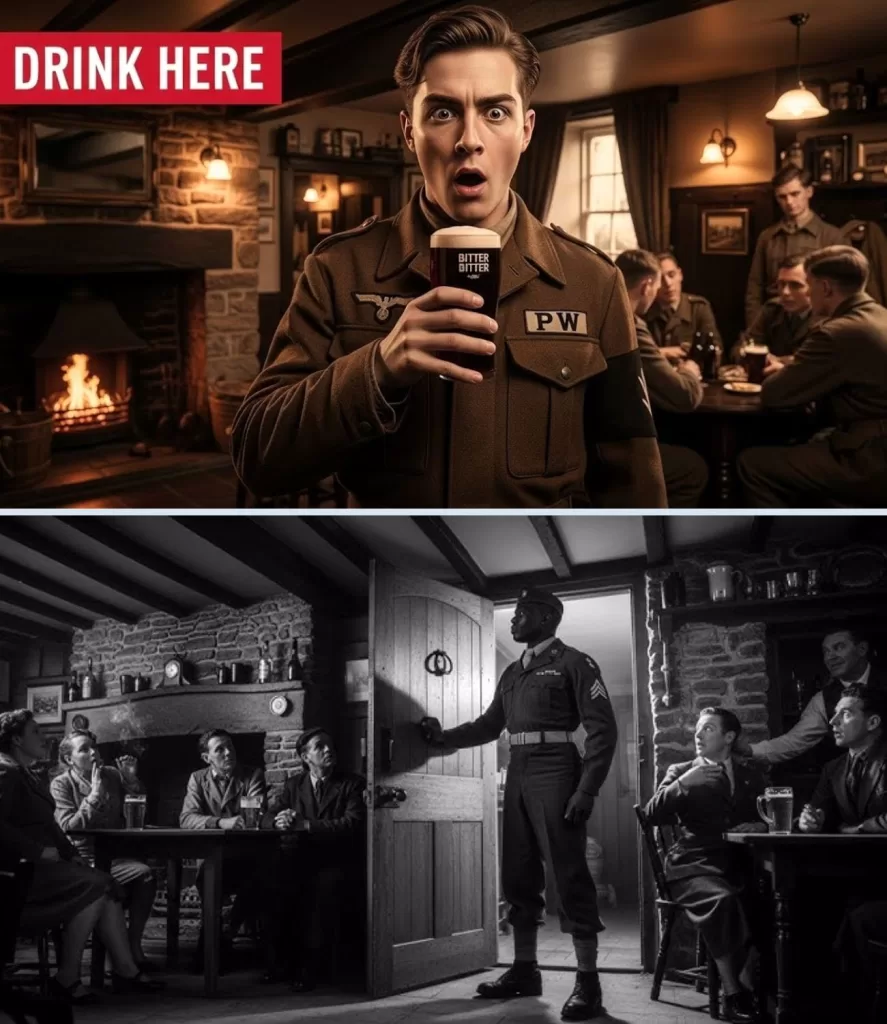
That was how Bowman found himself standing outside the Red Lion pub at 7:23 p.m., watching Sergeant Thompson hold the door open and motion for him to go inside. The pub stood on Culworth’s main street, a stone building with a slate roof and small windows partly covered by blackout curtains. Voices drifted from within—English voices, civilians, citizens of a nation at war with his own. Thompson gestured once more, and Bowman stepped through the doorway.
The room was comfortably warm, with a coal fire glowing in the stone fireplace along the far wall. Around twenty people filled the space—men and women seated at wooden tables, gathered around the bar, chatting, smoking, and drinking. As Bowman entered with the other eight German prisoners, the conversations quieted. Every face turned toward them. He recognized the expression immediately. The PW insignia on their uniforms told the story. German prisoners. Enemy troops.
The quiet lasted about five seconds before an elderly man with white hair, dressed in a tweed jacket and standing at the bar, lifted his pint in greeting and gave a small nod. Thompson guided the prisoners to a table in the corner beside the fireplace. The landlady, Mrs. Crawford, approached carrying a notepad, exchanged a few words with Thompson, and then he addressed the prisoners.
“Every prisoner was allowed one pint, paid for by the British Army. They were free to sit, drink, and speak quietly, but they were not permitted to leave the pub or approach other patrons without authorization.”
Bowman simply ordered the same drink as Thompson: bitter. He had never encountered it before. Five minutes later, Mrs. Crawford returned carrying nine pint glasses filled with a dark amber beer. Without saying a word, she placed them on the table. Bowman lifted his glass and studied it in disbelief. This was the sort of thing that was never supposed to happen. Wars were not meant to include enemies sharing drinks in a public house, yet there it was, impossible to deny.
The beer was served warm, with a rich yeasty flavor that bore little resemblance to the lager Bowman remembered from Munich. He sipped it slowly while watching the other patrons settle back into their conversations. The uneasiness that had filled the room gradually disappeared. People stopped watching the prisoners. Before long, the pub had slipped back into its usual routine, filled with conversation, laughter, and soft music drifting from the radio behind the bar.
Bowman found himself sitting in the corner of an English pub, drinking British beer while British civilians did exactly the same thing only ten feet away. The situation felt completely surreal. At a nearby table, Thompson and the two other guards drank their own pints of bitter while keeping an eye on the prisoners. Their watchfulness was calm rather than threatening. They appeared relaxed and chatted among themselves.
About twenty minutes later, one of the guards, a corporal named Davies, came over and, in hesitant German, asked whether the beer was satisfactory. Bowman replied that it was. Davies explained that his father had served in the First War, had been captured by the Germans in 1917, and had received good treatment in a camp near Hamburg. He seemed to believe that history carried weight, that kindness in the past created a responsibility in the present. Unsure how to respond, Bowman simply nodded.
By 8:00, Bowman had emptied his pint. Holding the vacant glass, he watched the life of the pub continue around him. Mrs. Crawford moved from table to table collecting empty glasses, taking fresh orders, and chatting with customers. She treated the German prisoners no differently from anyone else—courteous, efficient, and without making them the center of attention. The elderly man from the bar, who had nodded earlier, walked over to Thompson and asked whether the prisoners might like another round. Thompson answered, “No, one per man was the rule.” The man accepted the decision without argument and returned to his place. Even so, the offer stayed with Bowman. An English civilian had wanted to buy drinks for German prisoners during a war that had already claimed hundreds of thousands of lives. What kind of nation behaved that way?
At 8:45, Thompson rose and announced that it was time to head back to camp. The prisoners finished their drinks, got to their feet, and made their way to the door. As they left, several customers called out, “Good night.” It was not exactly warm, but neither was it unfriendly. It was simply an acknowledgment. The prisoners climbed into the back of the truck and rode silently to Camp 174. Bowman could not find any words. Nothing he might have said could explain what he had just experienced.
That evening, after returning to the hut, Bowman wrote a letter to his sister in Munich. Because every letter was subject to censorship, he could not mention the camp’s location, the number of guards, or any other military information. He was limited to describing his health and the general conditions. He wrote that he was safe, that the British were treating him fairly, and that he had gone to a pub that night. He was certain his sister would never believe that final detail. In truth, he could hardly believe it himself, even though it had really happened.
Throughout October and November, the pub outings remained part of camp routine. Every other week, subject to work records and the availability of guards, prisoners with consistently good conduct could volunteer to spend a supervised evening at the Red Lion or another pub in a nearby village. Each trip followed an identical schedule: nine prisoners accompanied by three guards, two hours at the pub, then back to camp before curfew. Although the guards carried rifles every time, they never had cause to use them. Not a single prisoner tried to flee. There was little point—they were deep in the English countryside, hundreds of miles from the coast, dressed in uniforms clearly marked PW. While escape was possible in theory, it was effectively unrealistic in practice. Most of the prisoners had no desire to attempt it anyway.
Life at Camp 174 was an improvement over what they had endured in the Wehrmacht during the closing stages of the Normandy campaign. They received regular meals, had shelter, and no longer lived under artillery fire or the constant danger of Allied fighter-bombers attacking the roads. The ever-present expectation of death had disappeared. Some prisoners described their situation as a strange form of captivity—surprisingly comfortable yet entirely unfamiliar. Bowman saw it differently. To him, it was a glimpse of civilization.
The other possibility was to remain in the war, which by the end of 1944 meant falling back into Germany, holding defensive positions against overwhelmingly stronger Allied forces, or being transferred to the Eastern Front, where Soviet offensives were wiping out entire armies. That path led either to death or to capture under harsher circumstances. So Bowman harvested wheat, joined the pub visits whenever he had the chance, played chess in the hut, and waited for the conflict to end.
Farm work carried on through October and into November, and Bowman steadily became skilled at agricultural labor. By the fourth week, he was finishing his assigned quota by 3:30 each afternoon, leaving him an hour and a half to relax before the truck arrived to take everyone back to camp. He usually spent those ninety minutes beneath the trees, eating apples from the orchards and observing the British farm workers. The farmers themselves changed from time to time. Some were older men considered too old for military service, while others were younger men whose roles in agriculture had been deemed essential, exempting them from conscription. There were also women serving in the Land Army, civilians working the fields in place of men who had entered the armed forces. None of these workers appeared especially warm or openly hostile toward the German prisoners. They approached the situation practically. The farms required workers, and the prisoners supplied the labor. Completing the harvest before the weather changed mattered more than personal opinions.
November brought a change in assignments as the harvest drew to a close. Whitmore, the farmer, informed the prisoners that they would be transferred to new jobs. Some were sent to forestry projects in the Midlands, while others were assigned to maintenance work at military sites. Bowman’s group was dispatched to help expand a munitions factory near Daventry. Their duties involved construction, including excavating foundations, laying bricks, and installing drainage systems. The schedule remained unchanged, from 7:00 until 5:00, but the work demanded far more physical effort than farming. Bowman had never worked in construction before, so he learned by watching demonstrations and correcting mistakes as he went. The British civilian contractors overseeing the project were strict yet patient. They demonstrated each task once, expected the prisoners to perform it correctly right away, and corrected errors calmly rather than angrily.
By December, Bowman had accumulated 40 shillings in camp vouchers. He used the money at the camp canteen to buy cigarettes, writing paper, and chocolate whenever it was available. The canteen also stocked razor blades, soap, and boot polish, small necessities that made imprisonment easier to endure. Bowman chose razor blades and soap. Even as a prisoner, he preferred to keep himself clean. It was one of the few aspects of his life that remained within his control.
Information about the war reached the camp gradually through newspapers that the guards left in the recreation hut. By December 1944, Allied forces had liberated France and Belgium and were advancing toward Germany’s western frontier. In the east, Soviet armies were pushing across Poland. Germany was now fighting on several fronts against opponents with greater manpower and resources. Bowman understood what those numbers meant. Germany had no path to victory. The only uncertainty was how much longer the war would last and how many additional lives would be lost before surrender came. He hoped it would end before he was repatriated. Remaining a prisoner in Britain was far better than returning to Germany as a soldier when the Allies crossed the Rhine.
In January 1945, the trips to the pub came to an end. Winter had set in, bringing snow across Northamptonshire and making the roads difficult to use. The guards announced that outdoor recreation would remain suspended until spring. Bowman believed the snow itself was not enough to prevent the outings, but he chose not to object. He understood they had always been a privilege rather than an entitlement, and privileges could be withdrawn without any justification. In place of the pub visits, the camp arranged other forms of recreation, including football matches between the huts, card competitions, and film showings in the recreation hall.
The camp screened British-made films, including documentaries and productions intended to maintain morale, with interpreters providing subtitles. One film Bowman saw was “In Which We Serve,” which followed British sailors serving in the Royal Navy. It depicted British servicemen as courageous and highly disciplined. Bowman regarded it as propaganda, although he admitted it was persuasive. The other prisoners watched without speaking, and when it ended, no one offered any comments. Throughout the winter of 1945, food supplies remained sufficient: vegetable soup, bread, margarine, tea, and meat whenever it was available—the same wartime ration issued to British civilians. The prisoners did not put on weight, but neither did they go hungry.
When Bowman arrived at Camp 174 in August 1944, he weighed 148 lb. By March 1945, his weight had increased to 153 lb. The improvement showed clearly in his face, his posture, and the energy he carried. He was no longer the worn-out soldier who had surrendered in Normandy. In fact, he was in better health than he had been at any point during the previous 2 years.
Everything changed in May 1945 when the food ration was reduced. Germany surrendered on May 8th, bringing the war in Europe to an end. Two days later, the camp authorities assembled all the prisoners in the main compound yard. Standing on a platform, the commandant, Major Harrison, explained that reports from Germany had reached Britain describing the concentration camps. Newspapers had published photographs from Bergen-Belsen and Buchenwald—starving prisoners, mass graves, and gas chambers. The images had shocked the British public, and Parliament was pressing for German prisoners of war to receive smaller rations as punishment. Harrison said he did not personally support the decision, but his instructions from London left no room for discretion. Food would be reduced, although the minimum standards required by the Geneva Convention would still be met. Prisoners would continue working, and the pub visits would not return.
The prisoners heard the announcement without objecting. There was little they could say. They insisted they had known nothing about the camps, and most maintained that position. During his service in the Wehrmacht, Bowman had occasionally heard quiet rumors about camps in the east, about transports carrying people away, and about subjects soldiers were expected not to discuss. At the time, he had dismissed those stories as Allied propaganda meant to vilify Germany through exaggeration. The photographs, however, could not be denied, and neither could the testimony.
After the assembly ended, Bowman sat alone in his hut, struggling to absorb what he now understood. Germany had done more than lose the war; it had carried out crimes that would shape the country’s reputation for generations, and he had been connected to that history. He had not served as a camp guard—he had fought in France as a tank gunner—but he had worn the uniform, served the regime, and fought on its behalf. In his own mind, that made him complicit. The other prisoners avoided the subject, preferring to think about surviving, returning home, and rebuilding their lives. Bowman found himself unable to do the same. The photographs remained fixed in his memory, and the evidence refused to leave him.
By August 1945, the camp administration had restored more generous meals after the first wave of public outrage had eased. Even so, the mood inside the camp was no longer the same. The guards kept a greater distance and behaved with increased formality. The easy, informal exchanges disappeared. The pub outings never returned. Recreational activities still took place, but they carried a different atmosphere. Although the war had ended, its consequences were only beginning to unfold.
Bowman stayed at Camp 174 until January 1946. Repatriation moved slowly. Thousands of German prisoners remained in camps throughout Britain, and returning them to Germany required careful coordination between the British and American authorities, who were simultaneously dealing with millions of displaced people across Europe.
Bowman’s journey home began on January 18, 1946. Together with 200 fellow prisoners, he was put on buses to Liverpool, where they boarded a transport ship headed for Hamburg. The crossing lasted three days. He spent much of it below deck, gazing at the steel wall before him as he reflected on the previous 17 months. In 1943, he had departed Germany as a soldier; in 1946, he was coming back as a prisoner carrying memories of harvesting wheat in Northamptonshire and drinking bitter in an English pub while British civilians quietly sat nearby and paid him no attention.
On January 21, the ship arrived in Hamburg. After being processed through a British transit center, the prisoners were placed on southbound trains. Bowman reached Munich on January 25. The city lay in ruins, with entire neighborhoods reduced to piles of rubble after years of Allied bombing. Refugees crowded the streets alongside former soldiers and displaced people searching for missing relatives.
Bowman located his sister in what was left of their old neighborhood, where she was living in two rooms inside a damaged apartment building. His father had been killed during an air raid in 1943. His mother had died from illness and malnutrition in early 1945. His younger brother had lost his life in Hungary in December 1944. His sister had survived by working in a parachute factory until it was destroyed by bombing in March 1945.
He remained with his sister in those two small rooms while searching for employment, but jobs were almost impossible to find. The economy had collapsed, and money had little value. Instead of cash, people exchanged cigarettes and food. Drawing on the skills he had gained in Britain, Bowman found work in construction, clearing debris and repairing damaged buildings. The wages were meager, yet enough to buy food on the black market. He spent 14 hours a day, seven days a week, helping rebuild a city whose recovery would take decades.
Bowman rarely mentioned Britain. Whenever anyone asked where he had spent the war, he simply answered, “Normandy,” and said nothing more. Yet Britain remained on his mind. He remembered the Red Lion pub, drinking warm bitter while Mrs. Crawford gathered empty glasses, and Sergeant Thompson holding the door open for him. He often reflected on the strange reality that enemies had shared the same village pub during a war that claimed millions of lives. Over time, he came to understand that taking him there had never been an attempt to humiliate him. The British had wanted to remind him that he was still a human being—that war did not erase human dignity, and that even prisoners, even enemies, deserved basic respect. That was the lesson he carried with him. Not that Britain had been flawless, nor that the war itself had been justified, but that humanity could endure even under the darkest conditions if people chose to protect it.
Bowman spent the remainder of his life in Munich. He married in 1951, raised two daughters, worked as a construction supervisor, and eventually established a small building company. He never went back to Britain and never attempted to contact Sergeant Thompson, Mrs. Crawford, or any of the guards and farmers he had known at Camp 174. One reminder of those years stayed with him, however: a small beer mat from the Red Lion pub that he had quietly slipped into his pocket on an October evening in 1944.
The beer mat was made of cardboard, worn with age, and bore the pub’s name in black lettering. Bowman carried it in his wallet for the rest of his life. After his death in 1991, his daughters discovered it and asked their mother about it. She explained that their father had been a prisoner of war in Britain and that the British had treated him kindly—better than he had expected, and better than he likely believed he deserved considering what Germany had done.
Today, the beer mat is displayed in a small exhibition at the Bavarian Army Museum devoted to the experiences of German soldiers and prisoners during World War II. Most visitors pass by without giving it a second glance. At first sight, it appears no different from countless other artifacts from the 1940s: a simple piece of cardboard with the name of a pub printed on it. Yet it represents something far greater. It stands as evidence of two hours on an autumn evening in Northamptonshire when enemies were allowed to remain human. It is proof that even in war, even in captivity, even between nations determined to destroy one another, humanity can survive when people choose to preserve it.
